June — a month of two extremes. What is the market paying storage for?
In a single month the Polish system showed storage both faces of the future: a midday PV oversupply and an evening shortage that shifted the flexibility premium.
In a single month the Polish system showed energy storage both faces of the future. At midday a surplus of solar energy pushed prices below zero, while in the evening of 30 June — the day of a capacity alert — prices on the day-ahead (DA) market exceeded PLN 2,000/MWh. The flexibility premium moved between these extremes as well.
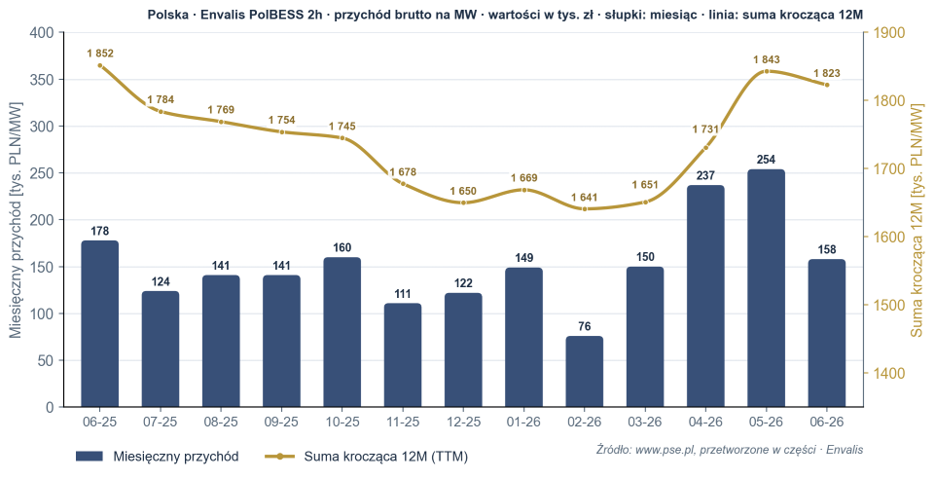
Over the last 12 months a reference two-hour storage asset (1 MW / 2 MWh) earned PLN 1,823,360 gross per MW of power, of which June alone brought PLN 158,299.
Methodology. Envalis PolBESS is a historical, monthly benchmark of the gross revenue of a reference storage asset (1 MW / 2 MWh) on the Polish market, computed by the Sentinel engine on real market data. It is not a forecast or a valuation of any specific project. Full methodology: envalis.energy.
Readiness still rules
Where does this revenue come from? Still, above all, from remuneration for readiness to provide system services — that is, keeping the storage asset in a state that allows it to respond in the required direction. It was precisely this element that accounted for most of the June result.
Storage also earns, however, when it is actually activated. Activation energy had a noticeable share in June and its importance is gradually growing. By far the weakest performer was classic day-ahead arbitrage. The spring flattening of prices meant its contribution to the June result was almost zero.
The conclusion remains unchanged: almost the entire revenue of a storage asset still rests on system services, and within them above all on remuneration for readiness. This is at once the greatest strength and the greatest weakness of the current business model.
It is worth distinguishing the two directions of this readiness. Upward regulation means an obligation to deliver energy when the system is short of it. Downward regulation is readiness to absorb an energy surplus. It is the change in the relationship between these two products that best explains the events of June.
A weaker month, but not a weaker market
The June result was more than 30% lower than the PLN 254k achieved in May and PLN 237k in April. This does not, however, mean a deterioration of the market. It is rather a recurring, springtime phase of oversupply, when the system has the greatest output from photovoltaics and wind while demand is close to its annual minimum.
Importantly, despite the weaker month the annual earning capacity barely changed. The rolling 12-month result fell only from PLN 1.843m to PLN 1.823m per MW, remaining very close to this year's maximum reached in May.
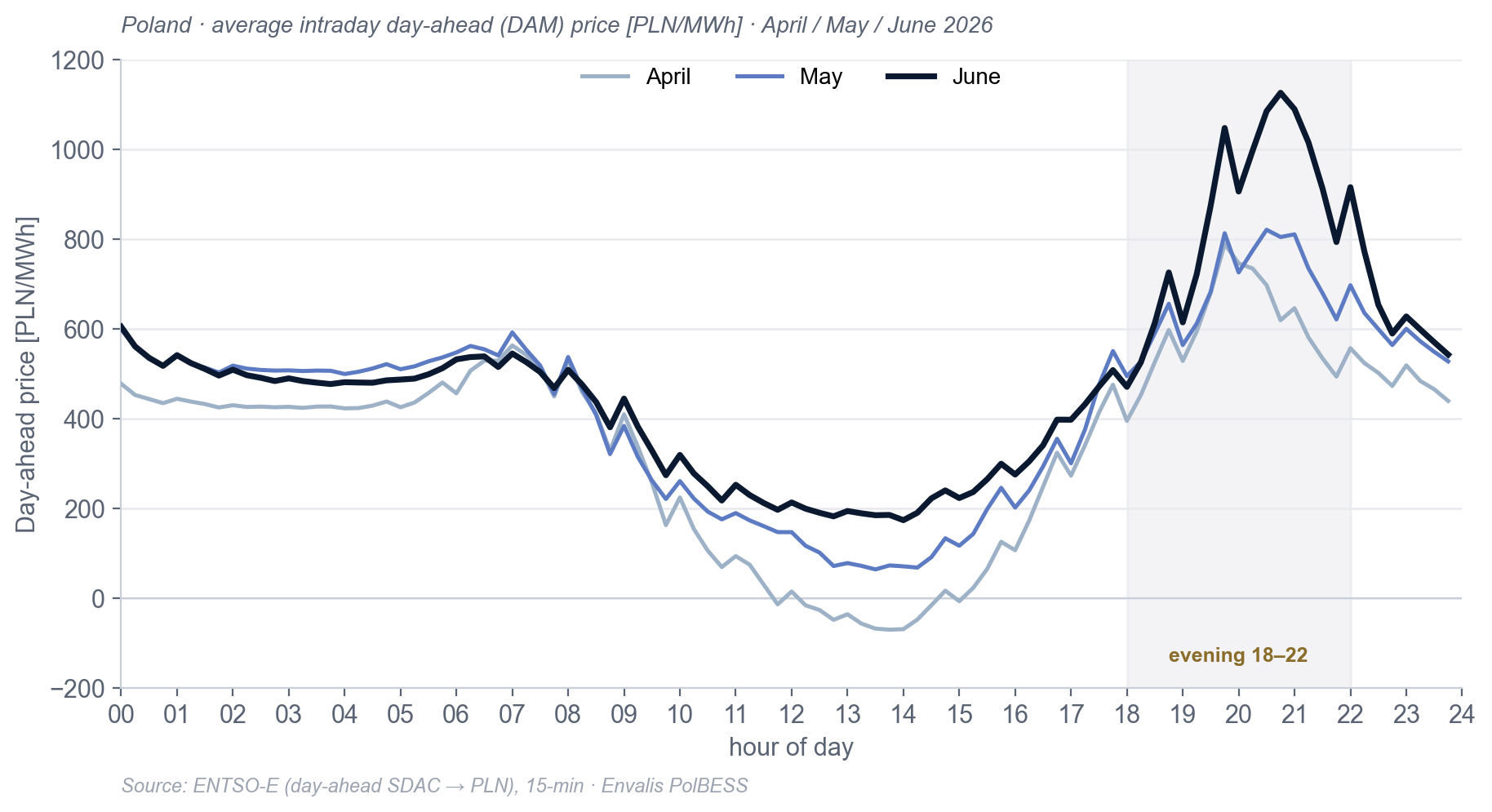
This is best seen in the daily price profile. The duck curve is becoming ever steeper. The average midday price rebounded from its April low — from -15 PLN/MWh in April, through 110 PLN/MWh in May, to 203 PLN/MWh in June. The prices of the evening "neck" rose even faster: 601, 682 and 845 PLN/MWh respectively. As a result, June brought the widest gap between the midday trough and the evening price peak.
The premium changed direction
Day-ahead prices show where tension is building in the system, but in the PolBESS benchmark the storage asset captures most of the value not through energy arbitrage, but through the provision of system services. And it is there that the change is most visible.
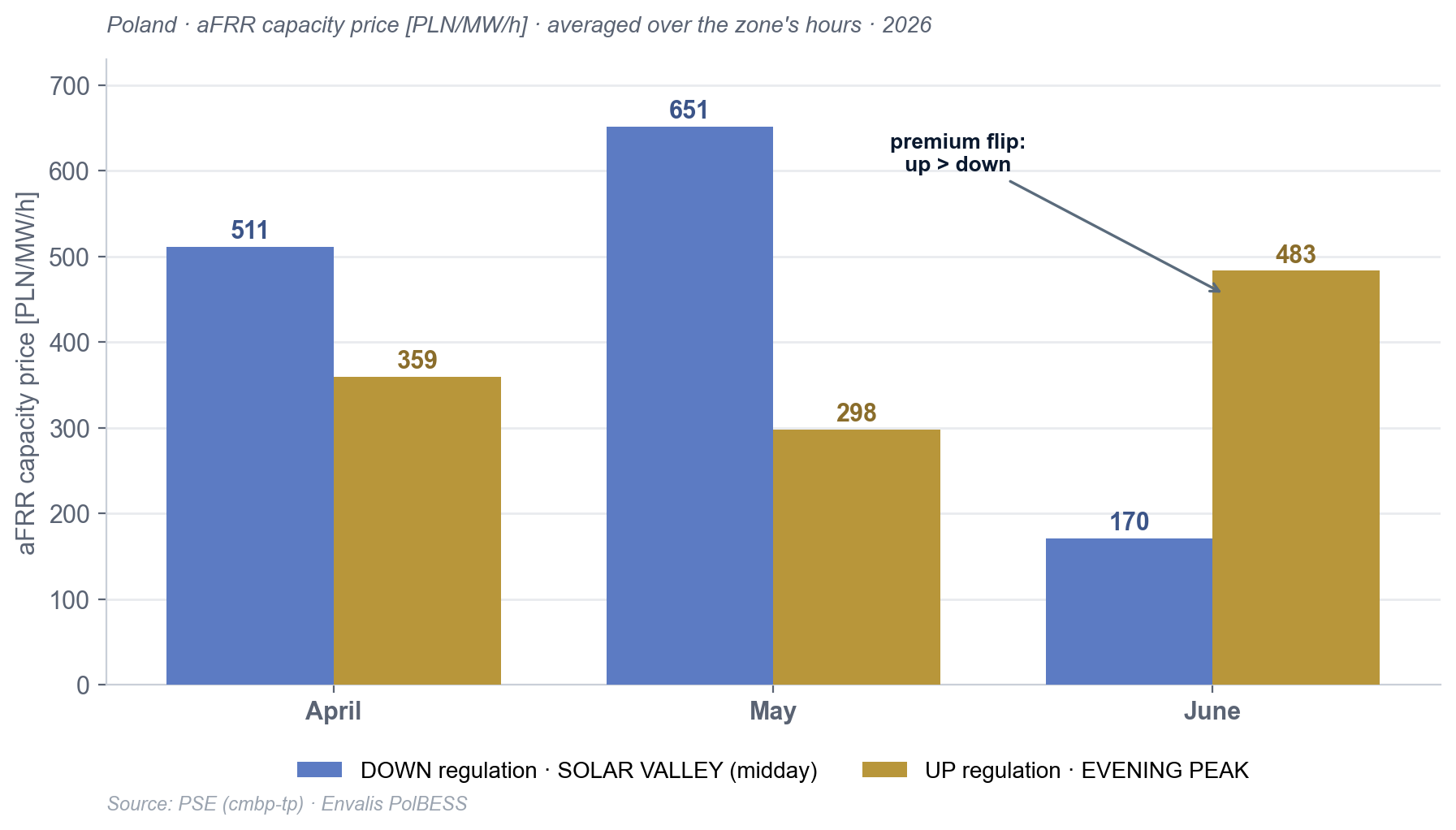
In spring the most highly valued product was readiness for downward regulation in the Solar Valley zone — that is, in the hours of peak PV output. In April it stood at 511 PLN/MW/h, and in May it rose to 651 PLN/MW/h. In the period of peak solar output, the ability to absorb the surplus was simply the most valuable service.
At the same time, upward regulation in the Evening Peak was valued much lower — at 359 and 298 PLN/MW/h respectively.
June reversed this relationship. The price of readiness for downward regulation in the Solar Valley fell to 170 PLN/MW/h, while upward regulation in the Evening Peak rose to 483 PLN/MW/h. For the first time since spring, the most valuable thing turned out to be the evening ability to deliver energy.
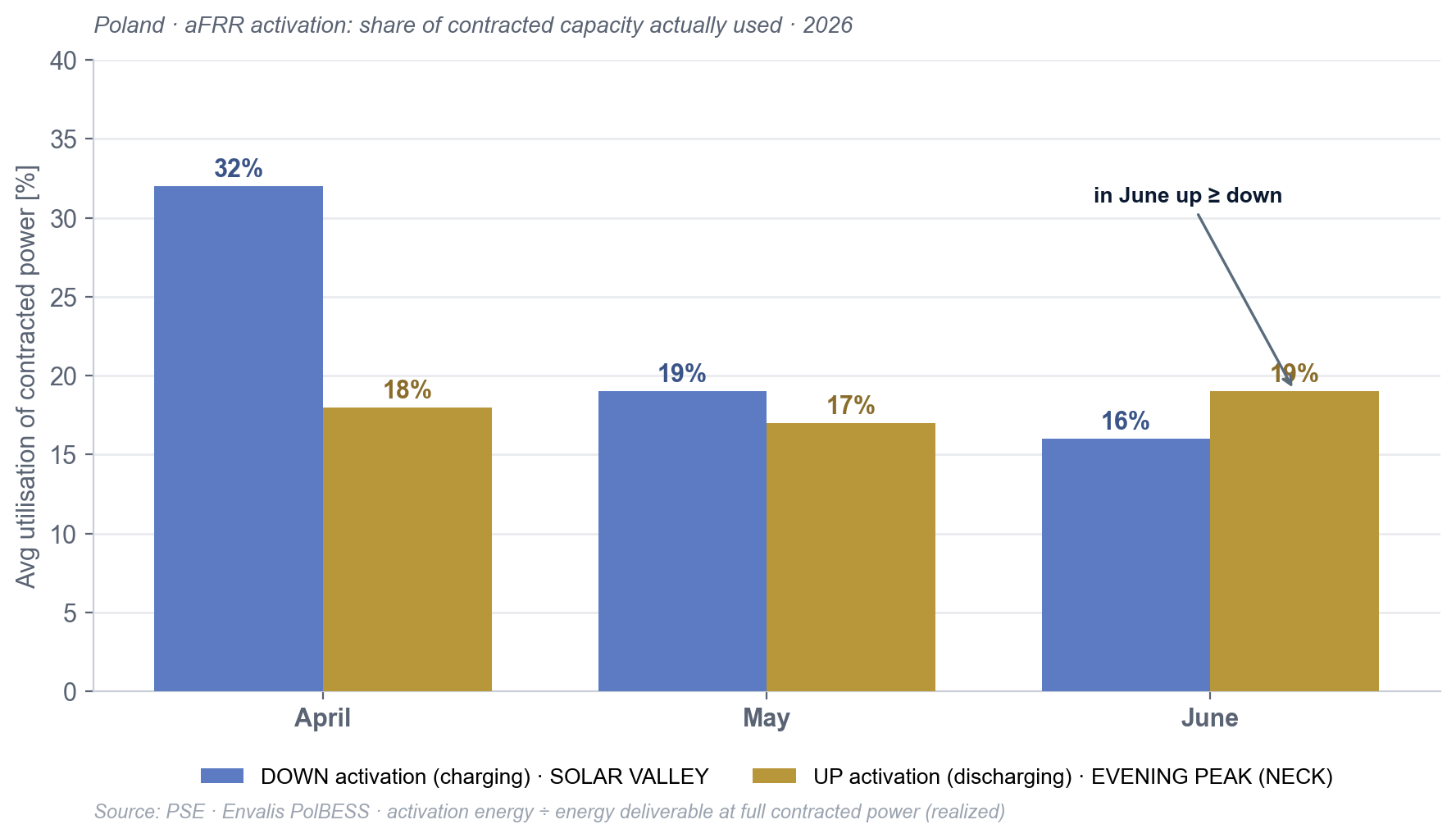
This is also confirmed by data on the actual activation of storage assets. In spring the operator most often used them to absorb energy surpluses in the middle of the day. In the following weeks the number of such activations fell, while calls to deliver energy in the evening appeared more and more often. The direction of the storage assets' actual operation thus shifted in exactly the same way as the valuation of readiness changed.
The evening that showed the future
The symbolic culmination of this process was the last day of the month.
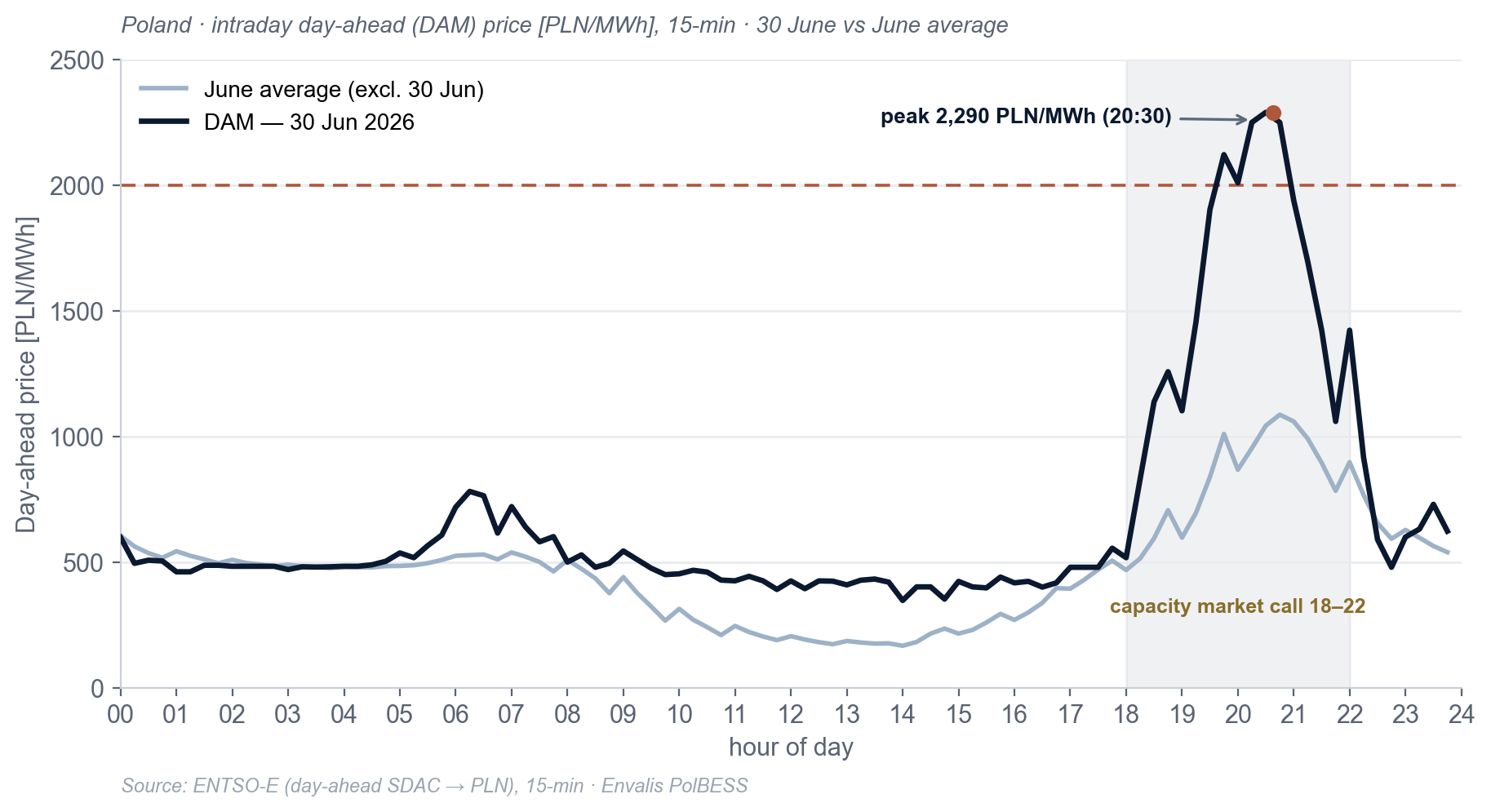
On 30 June, during a heatwave, PSE for the third time in history triggered the capacity alert mechanism, obliging units holding capacity contracts to make their capacity available to the operator. This applied to the hours from 18:00 to 22:00, when photovoltaic output fell practically to zero while demand — driven by air conditioning — remained high.
The situation was made worse by outages at the Kozienice (200 MW) and Turów (444 MW) units and by weak wind generation. The reserve shortfall reached 400–800 MW, and energy prices on the day-ahead market exceeded 2,000 PLN/MWh in those hours — more than four times the average for a typical June day of around 480 PLN/MWh.
It is worth separating two mechanisms here. The capacity alert concerns the capacity market — a separate instrument based on capacity contracts. The revenues included in the benchmark, on the other hand, come from balancing services (aFRR). That evening the capacity market was above all a signal of rising tension in the system, and not a direct source of storage revenues.
This is only the start of the change
These two faces of a single month — the midday PV oversupply and the evening shortage pushing prices above 2,000 PLN/MWh — best show why the flexibility premium shifted from downward to upward regulation.
This does not mean that storage assets stopped charging and began only discharging. The operating cycle stays the same. What changed was the direction for which the system pays the highest remuneration. In spring the premium went to the ability to absorb energy surpluses in the middle of the day. In June the most valuable thing became readiness to deliver energy in the evening.
Importantly, this is not classic energy arbitrage. The storage asset captures this value above all through the provision of system services. The system pays not for buying energy cheaply and selling it dearly, but for readiness to respond exactly when it is most needed. That is why the duration of the storage asset and its availability in the evening hours are becoming ever more important — they determine how much value can be offered in the most sought-after direction of regulation.
There is, however, another side of the coin. At present almost all revenue comes from a single source. Today this is a comfort, but in the future it will become a risk. As the number of storage assets grows, readiness prices will gradually fall and the weight of revenues will shift towards activation and energy arbitrage.
Today's high storage revenues in Poland are not a durable competitive advantage. They are above all a consequence of the system's low flexibility and the still small number of operating batteries. As successive projects come online, service prices will move towards the levels seen on more mature markets. The winners will be those who are already building a business model based on many revenue sources, and not solely on remuneration for readiness.
June turned out to be a miniature of the market we are heading towards. In a system with a growing share of renewables the scarce good is no longer energy, but flexibility — and storage is its purest form.
Because in the energy sector of tomorrow the winner will not be the one who has the most energy, but the one who can deliver it exactly when it is most needed.